
The single most effective way to get paid on time as a freelancer is to require a 50% deposit upfront, use Net 15 payment terms, and include a 1.5% monthly late fee clause in every contract. These three elements, proven through industry research and legal precedent, turn payment from a hope into an expectation.
Late payments are a crisis, not a frustration. According to the Freelancers Union's "Freelancing in America" study, 29% of freelance invoices are paid late, and 74% of freelancers have experienced complete non-payment at least once. For small businesses, the stakes are even higher. Fundbox research found that $825 billion in unpaid invoices are outstanding across the U.S. at any given time.
This guide provides the exact contract language, negotiation strategies, and legal guardrails you need to protect your cash flow.
Table of Contents
- Net Terms Explained (Net 7, 15, 30)
- The Deposit and Kill Fee
- Enforcing Late Fees
- Red Flags in Client Contracts
- FAQ
Net Terms Explained
"Net 30" means payment is due 30 days after the invoice date. "Net 15" means 15 days. Which should you use?
The Origin Problem
Net 30 originated in manufacturing, where physical goods needed transit time and accounts payable departments processed paper checks. Neither applies to modern freelance work. Your deliverable arrives instantly via email. Their payment can arrive in 24 hours via ACH. Net 30 is a relic.
Recommended Net Terms by Situation
| Your Situation | Recommended Terms | Rationale |
|---|---|---|
| New client, first project | Payment on Receipt | Trust is unproven |
| Ongoing retainer client | Net 7 | Regular relationship, fast cycle |
| Established relationship | Net 15 | Balance of professionalism and protection |
| Enterprise client with track record | Net 30 (maximum) | Only if they've proven reliability |
| Any client requesting Net 60/90 | Decline or negotiate | Unacceptable cash flow risk |
The Net 60/90 Trap
Large corporations routinely request Net 60 or Net 90 as "standard policy." This is not standard. It is a cash flow strategy that transfers wealth from small vendors to large corporations. Consider: A freelancer earning $100,000 annually who accepts Net 60 instead of Net 15 has approximately $12,000 of their own money tied up in outstanding invoices at any given moment. If they're carrying credit card debt at 20% APR while waiting for payment, that "policy" costs them $2,400 per year.
The response: "I understand your standard terms are Net 60. For independent contractors, extended terms create significant cash flow challenges. My standard is Net 15. Would that work, or could we discuss a 50% upfront payment with the balance on Net 30?"
Most "non-negotiable" policies have exceptions. You simply have to ask.
The Deposit and Kill Fee
Why 50% Upfront Is Standard
Requiring a deposit is professional, not aggressive. According to industry surveys compiled by the Editorial Freelancers Association and AIGA, 50% upfront is the most common deposit structure for projects over $1,000. The psychology works in your favor: clients who pay upfront are invested. They respond to emails faster, provide feedback promptly, and are far less likely to ghost mid-project. The sunk cost effect turns their behavior.
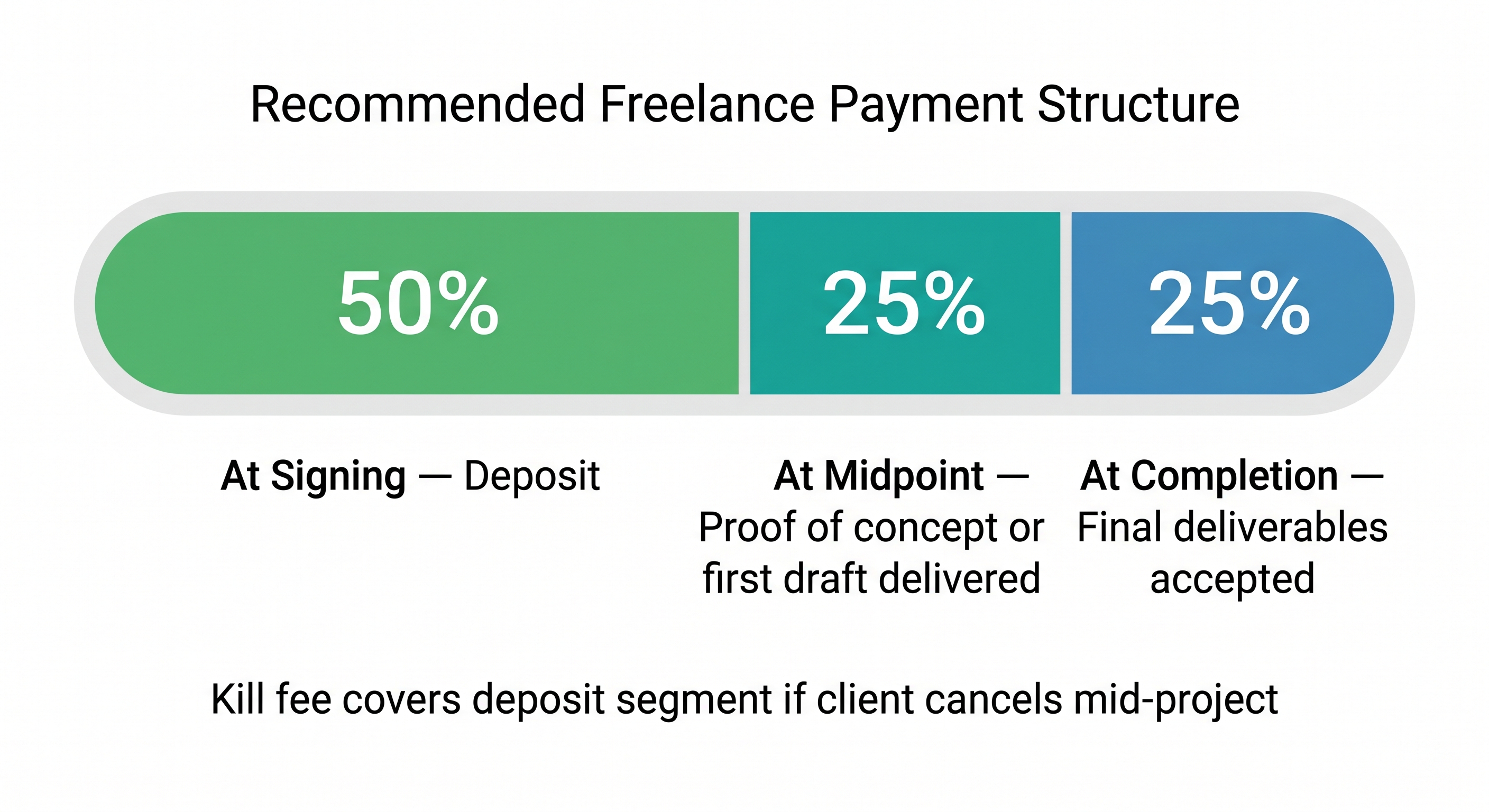
Optimal payment structure for projects over $1,000:
- 50% upon contract signing (before work begins)
- 25% at project midpoint (tied to a specific deliverable)
- 25% upon completion (Net 15 from final delivery)
This limits your exposure to 25% of the project value at any time.
The Kill Fee: Your Cancellation Protection
A "kill fee" compensates you when a client cancels mid-project. Industry standards vary:
| Industry | Standard Kill Fee |
|---|---|
| Photography | 50% of total fee (ASMP guidelines) |
| Graphic Design | 25-50% of remaining balance (AIGA) |
| Writing/Editorial | 25% kill fee (Editorial Freelancers Association) |
| Web Development | 100% of completed work + 25% of remaining |
Designer Mike Monteiro captured the necessity in his influential 2011 talk "Fuck You, Pay Me": "The minute they think they can get away without paying you, they will not pay you." The talk has been viewed over 1.5 million times and remains a foundational reference for freelancer payment rights.
Sample kill fee clause:
If Client cancels this project after execution of this Agreement: (a) all work completed to date shall be billed at Contractor's standard hourly rate; and (b) Client shall pay a cancellation fee equal to twenty-five percent (25%) of the remaining unpaid project balance.
Enforcing Late Fees
The 1.5% Standard
The most common late fee in commercial contracts is 1.5% per month, which equals 18% annually. This rate is:
- Legally enforceable in most U.S. states (California caps at 10% for certain transactions; Texas and Florida allow up to 18%)
- Industry standard across professional services
- High enough to motivate but low enough to be "reasonable" under judicial review
Courts evaluate late fees using a reasonableness test. Factors include whether the fee approximates actual damages from delayed payment, whether it's consistent with industry practice, and whether it was clearly disclosed before contracting.
What Won't Hold Up
Avoid these pitfalls:
| Problematic Approach | Why It Fails |
|---|---|
| 50% flat penalty | Courts view this as punitive, not compensatory |
| 5% per month (60% APR) | Usurious in most states |
| Compound interest without disclosure | May be unenforceable |
| Late fees on amounts in legitimate dispute | Courts may strike down |
Sample Late Fee Clause
Any invoice not paid within fifteen (15) days of the invoice date shall accrue interest at the rate of one and one-half percent (1.5%) per month, or the maximum rate permitted by applicable law, whichever is less, from the due date until paid in full. Client agrees to pay all costs of collection, including reasonable attorney's fees, incurred in collecting any overdue amounts.
The phrase "or the maximum rate permitted by applicable law, whichever is less" provides automatic compliance with varying state usury laws.
The Psychology Behind Payment Timing
Payment speed reflects the power dynamic in the relationship, not just cash flow. Research from the Institute of Finance and Management shows that invoices sent within 24 hours of project completion are paid 1.5x faster than invoices sent a week later. The reason is psychological: the client still feels the value of your work when the deliverable is fresh. Wait a week, and the invoice feels like an afterthought. Wait a month, and the client has mentally moved on. Send invoices immediately, automate follow-ups at 3 and 7 days, and never let an overdue invoice go unmentioned past 14 days.
Red Flags in Client Contracts
Before signing a client's contract, watch for these problematic clauses:
| Red Flag | What It Means | Action |
|---|---|---|
| "Net 60" or "Net 90" | Extreme cash flow strain | Negotiate to Net 30 maximum; request deposit |
| "No late fees" or "Late fees waived" | Removes your enforcement mechanism | Redline and negotiate |
| "Payment contingent on client receiving payment" | Pass-through risk to you | Reject entirely |
| "Payment upon acceptance" (undefined) | Infinite delay mechanism | Define acceptance criteria and timeline |
| "Right to offset for any reason" | They can reduce payment unilaterally | Narrow to documented disputes only |
Large client contracts contain dozens of these clauses buried in dense legal language. AI contract review tools (Pact AI, Legitt AI, or ChatGPT) can identify problematic payment terms in seconds, flagging provisions that need attention before you sign.
Legal Framework
The federal Prompt Payment Act (31 U.S.C. § 3901-3907) requires government agencies to pay contractors within 30 days of receiving a proper invoice, with automatic interest penalties for late payment calculated at the Treasury rate. While this applies only to federal contracts, most states have enacted similar statutes for private transactions.
Late fee enforceability is governed by liquidated damages doctrine. Under Restatement (Second) of Contracts § 356, late fees must be a reasonable estimate of actual damages caused by delayed payment — not a penalty. Courts typically uphold interest rates of 1-1.5% monthly (12-18% annually) on overdue invoices as reasonable, while higher rates risk being voided as penalties.
State freelancer protection laws create additional payment requirements. California's Freelance Worker Protection Act (Lab. Code § 2778) mandates payment within 30 days of completion if no date is specified, with double damages for late payment. New York's Freelance Isn't Free Act (N.Y. Lab. Law § 191-c) requires payment within 30 days and provides for double damages plus attorney's fees.
Conclusion
Payment protection is professionalism, not distrust. Beyond payment clauses, make sure your contracts also address protecting your IP — tying intellectual property transfer to final payment gives you the strongest position. The most successful freelancers and small businesses treat payment terms as non-negotiable infrastructure, not awkward afterthoughts. The formula is straightforward:
-
Require 50% upfront before starting work
-
Use Net 15 terms (Net 30 maximum for proven clients)
-
Include a 1.5% monthly late fee with collection cost provisions
-
Add a kill fee for cancellation protection
-
Review every client contract for red-flag clauses before signing
Your expertise has value. Structure your contracts to reflect that.
Frequently Asked Questions

About Vlad Kuzin
Founder & CEO, Shepherdstack LLC
Vlad Kuzin is the founder of Shepherdstack LLC and creator of Pact, an AI-powered contract review tool. He builds software that helps individuals and small businesses understand the documents they sign.
Disclosure: Founder of Shepherdstack LLC, the company behind Pact. All comparison articles use a standardized evaluation methodology applied equally to all tools, including Pact.