
Freelancer Contracts: How MSAs and SOWs Stop Scope Creep and Guarantee Payment
Seventy-two percent of freelancers have experienced non-payment, with 59% owed $50,000 or more over their careers, according to the Freelancers Union. The fix is not better clients. It is better contracts. A Master Service Agreement (MSA) paired with project-specific Statements of Work (SOWs) creates a legal structure that defines scope, locks payment terms, and gives you enforceable rights when things go wrong.
Most freelancers start with handshake deals or one-page templates pulled from the internet. That works until it does not: until a client adds "one more revision" for the sixth time, until a $5,000 project balloons to $15,000 of unpaid work, until you realize the contract gives the client ownership of your intellectual property in perpetuity. The MSA-SOW structure solves these problems systematically, once, so you don't renegotiate the same terms on every project.
Why Freelancers Need Two Documents, Not One
The MSA: Your Master Terms
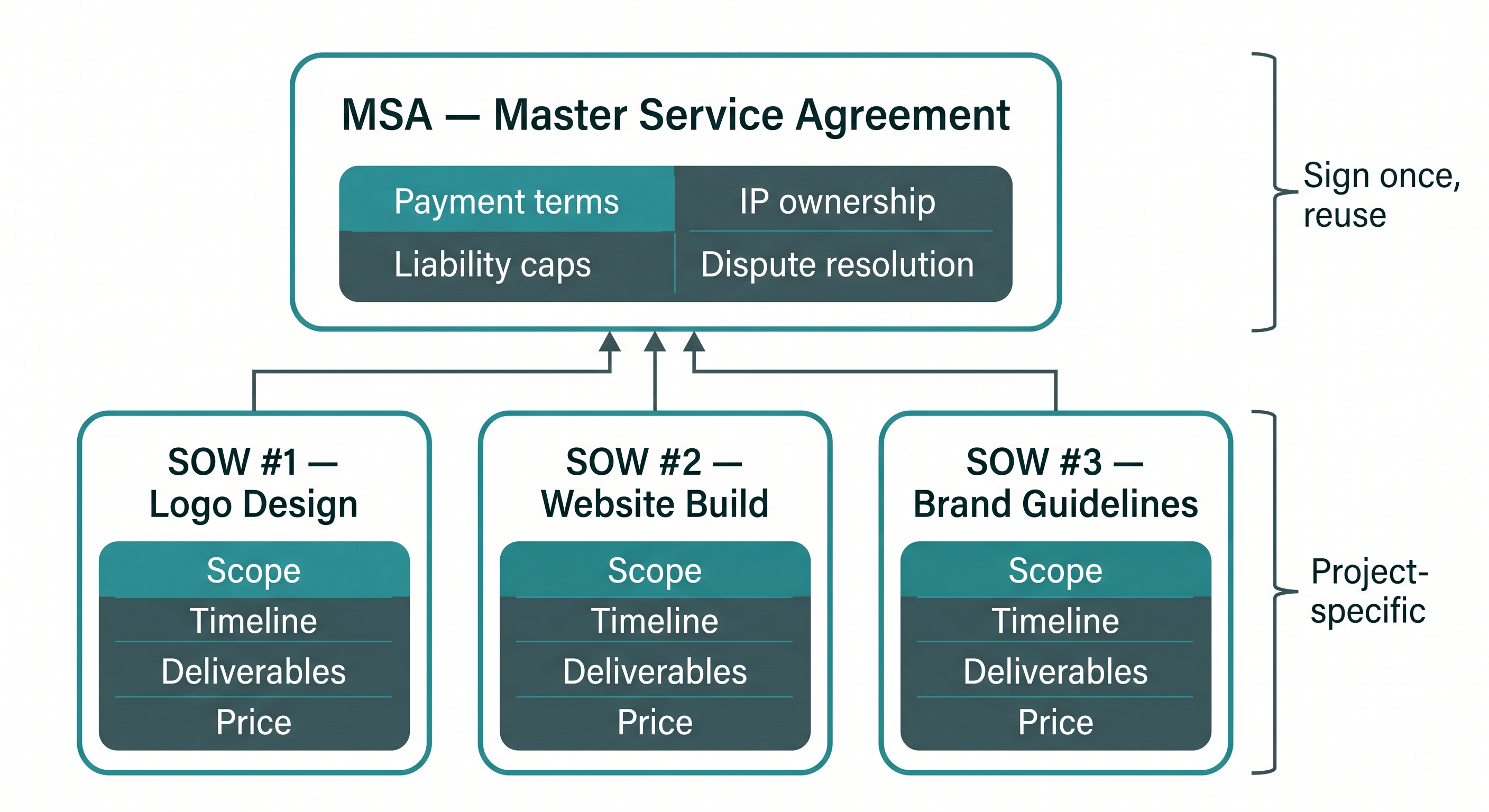
The Master Service Agreement covers everything that stays the same across projects: payment terms, intellectual property ownership, confidentiality, limitation of liability, dispute resolution, termination procedures, and indemnification. You negotiate the MSA once with each client. It governs every project you do together.
What belongs in the MSA:
- Payment structure (Net 15, Net 30, milestone-based)
- Late payment penalties (1.5% monthly is standard, matching credit card rates)
- IP ownership and licensing terms
- Confidentiality obligations (what's protected and for how long; see our NDA for freelancer projects guide)
- Liability cap (typically 1× total fees paid under all active SOWs)
- Dispute resolution method and venue
- Termination rights and notice periods
- Non-solicitation scope (if any)
The SOW: Your Project Scope
The Statement of Work covers everything specific to a single project: deliverables, timeline, revision limits, project fee, and acceptance criteria. Each new project gets a new SOW. The SOW references the MSA for general terms, so you do not renegotiate payment terms, IP clauses, or dispute resolution every time.
What belongs in the SOW:
- Project description (specific enough that both parties agree on "done")
- Deliverables list with format specifications
- Timeline with milestones and deadlines
- Total project fee and payment schedule
- Number of included revisions (typically 2–3 rounds)
- Acceptance criteria and sign-off process
- Out-of-scope items listed explicitly
The strategic advantage: When a client with an existing MSA wants to start a new project, you send a one-page SOW. No legal review needed for the general terms, which are already agreed to. As one Reddit user in r/freelance noted, "If you have repeat clients, get one MSA signed and then each new project is a short SOW that doesn't need its own round of legal review." This cuts time-to-signature from days to hours.
The Freelancer Contract Risk Assessment Checklist
Before signing any freelancer contract, whether a standalone agreement or an MSA+SOW pair, score it against these 10 risk dimensions. Each item is green (protected), yellow (partially covered), or red (unprotected or one-sided).
| # | Risk Dimension | Green (Protected) | Yellow (Negotiate) | Red (Walk Away or Fix) |
|---|---|---|---|---|
| 1 | Payment terms | Net 15 or milestone-based; deposit required before work starts | Net 30; no deposit but clear payment schedule | Net 60+; no deposit; payment "upon satisfaction" |
| 2 | Kill fee / cancellation | 25–50% of remaining project fee if client cancels after kickoff | Pro-rated payment for work completed to date | No kill fee; client can cancel without financial obligation |
| 3 | IP ownership | You retain IP until final payment; license granted on payment | IP transfers on payment; you retain portfolio usage rights | "Work made for hire" with all IP assigned on creation, before payment |
| 4 | Scope definition | Specific deliverables with format, quantity, and acceptance criteria | General description with deliverables listed | Vague scope: "all work related to the project" |
| 5 | Revision limits | 2–3 rounds included; additional rounds billed at stated hourly rate | "Reasonable revisions" included | Unlimited revisions included in fixed fee |
| 6 | Late payment penalty | 1.5% monthly interest on overdue invoices; right to pause work | Flat late fee ($25–$50) per overdue invoice | No late penalty; no right to pause work |
| 7 | Dispute resolution | Mediation first, then small claims or arbitration in your state | Arbitration in a neutral location | Litigation required in client's state |
| 8 | Non-compete scope | No non-compete, or limited to direct competitors for 6 months | Non-compete limited to 1 year, your industry | Broad non-compete: 2+ years, all "competing" businesses |
| 9 | Liability cap | Capped at 1× total fees paid under the contract | Capped at 2–3× fees | Uncapped; you're liable for all consequential damages |
| 10 | Termination notice | 30-day mutual notice; payment for all completed work | 14-day notice; payment for completed deliverables only | Client can terminate immediately; payment only for "accepted" work |
Scoring interpretation:
- 8–10 green: Standard professional contract. Sign with confidence.
- 5–7 green, rest yellow: Negotiate the yellow items before signing. Most clients will accept reasonable changes to 2–3 provisions.
- Any red items: Do not sign until fixed. Red items represent structural risk; they are not "minor details" to negotiate later.
Payment Terms That Actually Get You Paid
Non-payment is the #1 contract problem for freelancers. The contract structure itself determines whether you have enforceable rights or just a promise. For a deeper dive into structuring deposits, kill fees, and late fee clauses, see our guide on payment terms for freelancers.
The Deposit-Milestone-Final Structure
For projects over $2,000, split payments into three tranches:
1. Deposit (25–50% of project fee). Due before any work begins. This filters out non-serious clients immediately. As one freelancer on Reddit put it: "For new clients, I require a 75–100% retainer. Some scoff at that, but I always require a retainer to start work for new clients. No exceptions."
2. Milestone payment (25–50%). Due when a defined milestone is reached: first draft delivered, design approved, prototype completed. The milestone must be specific enough that there's no ambiguity about when it's been reached.
3. Final payment (remaining balance). Due on delivery of final deliverables. Critically: tie IP transfer to final payment. "All intellectual property rights shall transfer to Client upon receipt of full and final payment." This is your strongest enforcement position: the client cannot use the work until they pay for it.
Late Payment Enforcement
Your contract should specify:
- Interest on overdue invoices. 1.5% per month (18% annual) is standard commercial rate. California's Freelance Worker Protection Act establishes late payment penalties for freelance workers specifically.
- Right to pause work. "Contractor may suspend performance of all obligations under this Agreement if any invoice remains unpaid for more than 15 days past due."
- Right to withdraw deliverables. If final payment isn't received, you retain the right to revoke any licenses granted under the agreement.
Contract Signing Speed
The contract is only protection if it's signed before work starts. Delays in signing are common; freelancers on Reddit report that clients say "let's move forward" and then sit on the contract for days or weeks.
Two approaches that work:
1. Tie the deadline to the client's timeline, not yours. "If you want to keep the March 15 start date, the contract needs to be signed by March 10" is more effective than "Please sign within 5 business days." The deadline has a reason attached to it.
2. Bundle contract signing with deposit payment. Send the contract and the deposit invoice in the same email, same surface. "Sign + pay in one step" eliminates the second context switch that causes delays. One freelancer reported cutting average time-to-signature from 3 days to under 2 hours using this approach.
Scope Creep: The Contract Clauses That Stop It
Scope creep doesn't happen in one dramatic request. It happens in ten small ones: "Can you also adjust the header?" "Could you add one more page?" "Actually, we need this in three formats." Each request takes 30 minutes. Ten requests add 5 hours to a project. At $100/hour, that is $500 of unpaid work.
The Change Order Clause
Every freelancer contract needs a change order provision. Standard language:
"Any work outside the scope defined in the applicable SOW requires a written Change Order signed by both parties before work begins. Change Orders shall specify the additional deliverables, timeline impact, and additional fees. No additional work shall be performed without a signed Change Order."
This does two things: it makes the client conscious of scope expansion (they have to sign something), and it gives you documentation for billing the additional work.
The "Included vs. Not Included" Section
The most effective anti-scope-creep tool is not a legal clause. It is a list in the SOW that explicitly states what is not included. Example for a website project:
Included: Home page design, 5 interior page layouts, mobile responsive implementation, 2 rounds of revisions.
Not included: Content writing, stock photo sourcing, SEO optimization, hosting setup, ongoing maintenance, additional pages beyond the 5 specified.
When a client asks for content writing, you point to the SOW. The conversation shifts from "Can you do this?" to "This is outside the SOW. Here is a Change Order for the additional work."
IP Ownership: The Clause Freelancers Get Wrong
Under the U.S. Copyright Act (17 U.S.C. § 101), work created by an independent contractor is owned by the contractor, not the client, unless the contract specifically transfers ownership. The Supreme Court confirmed this in CCNV v. Reid (1989). This is the default rule, and it works in your favor as a freelancer.
But most client contracts include "work made for hire" language or blanket IP assignment clauses that transfer ownership on creation, before payment. This removes your enforcement position: if the client owns the work the moment you create it, they have no financial incentive to pay the final invoice.
Better IP structure for freelancers:
"Contractor retains all intellectual property rights in the Deliverables until Client has made full and final payment of all amounts due under this SOW. Upon receipt of full payment, Contractor hereby assigns to Client all right, title, and interest in the Deliverables. Contractor retains the right to display the Deliverables in Contractor's portfolio and marketing materials."
This structure gives the client full ownership, but only after payment. It gives you portfolio rights regardless. And it creates maximum pressure for collecting final payment.
For IP-heavy projects, consider licensing instead of assignment: the client gets an exclusive license to use the work, but you retain underlying ownership. This is standard for stock photography, template design, and reusable code libraries.
Non-Competes and Non-Solicitation: What Freelancers Should Accept
Non-compete clauses in freelance contracts restrict your ability to work for competing businesses. Non-solicitation clauses restrict you from contacting the client's customers or employees.
Non-competes: Push back hard. The FTC attempted to ban most non-competes in 2024 (the rule was struck down by a federal court, though states including California, Minnesota, North Dakota, and Oklahoma have enacted their own bans). For freelancers, a non-compete that prevents you from working in your industry for 1–2 years is devastating and effectively ends your business. If a non-compete is non-negotiable, limit it to: direct competitors only (named specifically), 6 months maximum duration, and the specific geographic market the client operates in.
Non-solicitation: More reasonable, but still negotiable. A clause preventing you from poaching the client's employees for 12 months is standard. A clause preventing you from working with anyone you were introduced to during the engagement is overbroad. Push for "active solicitation" language rather than "any contact."
Include a severability clause alongside any restrictive covenant. If the non-compete is struck down as overbroad, severability ensures the rest of your contract (including payment terms and IP provisions) survives.
Frequently Asked Questions

About Vlad Kuzin
Founder & CEO, Shepherdstack LLC
Vlad Kuzin is the founder of Shepherdstack LLC and creator of Pact, an AI-powered contract review tool. He builds software that helps individuals and small businesses understand the documents they sign.
Disclosure: Founder of Shepherdstack LLC, the company behind Pact. All comparison articles use a standardized evaluation methodology applied equally to all tools, including Pact.