
Arbitration vs. Mediation: How Dispute Resolution Clauses Set the Price of Justice
A dispute resolution clause determines whether you'll spend $2,000 or $200,000 resolving a contract conflict, and most people sign it without reading it. Arbitration produces a binding decision from a private judge you can't meaningfully appeal. Mediation produces a voluntary agreement you both shape. Litigation puts the dispute before a public court with full procedural rights. The method your contract mandates controls cost, timeline, privacy, and your ability to challenge an unfair outcome.
Most contracts default to the drafter's preferred method. That means the party with more negotiating power (a landlord, a corporate client, a platform) picks the dispute path that favors them. Understanding the mechanics of each method, and knowing which clauses to push back on, is the difference between protecting yourself and signing away your right to a fair fight.
How Arbitration Clauses Work in Contracts
Arbitration replaces the court system with a private proceeding. One or three arbitrators hear evidence, apply the law, and issue a binding award. Courts enforce arbitration awards under the Federal Arbitration Act (9 U.S.C. §§ 1–16) with extremely limited grounds for appeal: fraud, arbitrator corruption, or the arbitrator exceeding their authority.
The practical effect: once you agree to arbitration, you give up your right to a jury trial, to broad discovery, and to a meaningful appeal. The Supreme Court reinforced this in AT&T Mobility v. Concepcion (2011), ruling that the FAA preempts state laws that would otherwise allow class-action claims despite arbitration clauses.
What an arbitration clause actually controls:
- Administering body: AAA, JAMS, or ad hoc (no institutional rules)
- Number of arbitrators: one (cheaper) or three (more expensive, harder to get a rogue decision)
- Venue: where the hearing takes place (this is where hidden costs live)
- Fee allocation: who pays the arbitrator's $1,000–$2,500 daily fee
- Discovery scope: most arbitration limits document exchange and depositions
- Appeal rights: typically none, unless the contract specifies expanded review
Red flag to watch for: Contracts that specify AAA commercial rules for consumer or freelancer disputes. AAA filing fees start at $1,925 for claims under $75,000. If your claim is worth $5,000, the filing fee alone makes arbitration economically irrational, which is exactly the point. The Supreme Court of Canada recognized this problem in Uber Technologies Inc. v. Heller (2020 SCC 16), striking down an arbitration clause that required a $14,500 filing fee in the Netherlands for drivers earning approximately $20,800 annually.
How Mediation Works: Why 80% of Cases Settle
Mediation is a facilitated negotiation. A neutral mediator meets with both parties (sometimes together, sometimes in separate rooms) to identify common ground and push toward settlement. The mediator cannot impose a decision. Both sides must agree to any resolution.
JAMS reports that over 80% of mediated disputes reach settlement. The process costs $1,000–$5,000 total (split between parties), takes one to three sessions, and keeps the dispute private. Unlike arbitration, if mediation fails, you lose nothing. Both sides retain every legal right they had before walking in.
When mediation works best:
- The dispute involves an ongoing relationship you want to preserve (landlord-tenant, vendor-client, business partners)
- The disagreement stems from miscommunication or ambiguous contract terms, not fraud
- Both parties are motivated to resolve quickly
- The dollar amount is under $50,000 (below the threshold where full litigation or arbitration makes financial sense)
When mediation fails: If one party is acting in bad faith or using delay as a tactic, mediation becomes a stalling tool. In the Reddit thread about One Main Financial's arbitration clause, the court-ordered mediator reportedly pressured the debtor to abandon their contractual arbitration right and accept a mediated settlement, illustrating how mediators can push settlements that serve efficiency over fairness.
A mediation-first clause costs almost nothing to add and filters out the majority of disputes before they reach arbitration or court. The standard language reads: "The parties shall first attempt to resolve any dispute through mediation administered by [AAA/JAMS] before initiating arbitration or litigation."
Arbitration vs. Mediation: The Dispute Resolution Decision Matrix
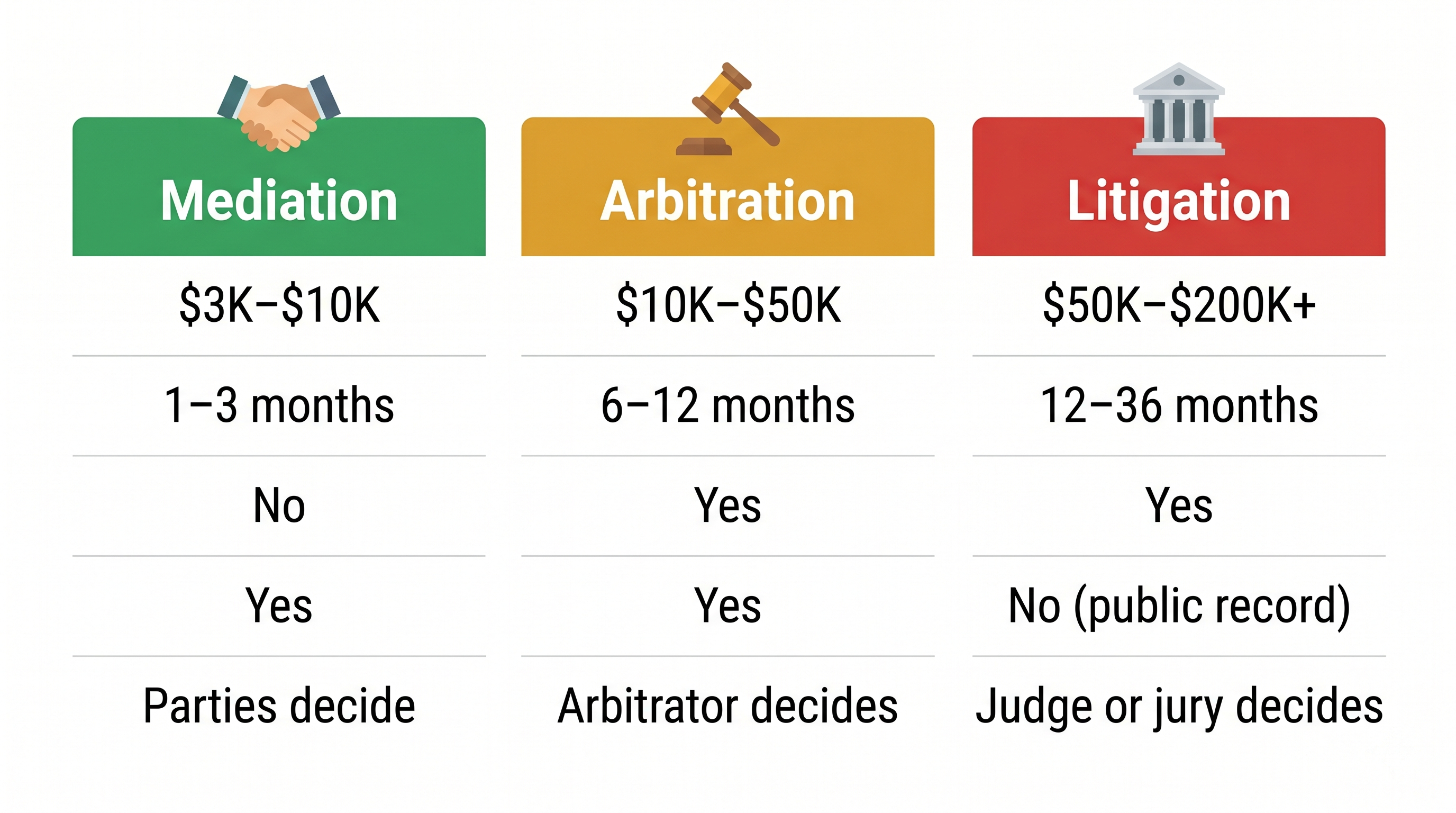
This comparison table scores each method across six dimensions. Use it to evaluate which method fits your specific contract type and risk tolerance.
| Factor | Mediation | Arbitration | Litigation |
|---|---|---|---|
| Typical cost | $1,000–$5,000 total | $10,000–$75,000+ | $50,000–$300,000+ |
| Timeline to resolution | 1–3 months | 6–18 months | 18–36 months (federal avg. 27.4 months per USCOURTS 2023 data) |
| Binding? | No — voluntary agreement | Yes — binding award, limited appeal | Yes — binding judgment, full appeal rights |
| Privacy | Private | Private (unless court enforcement needed) | Public record |
| Relationship preservation | High — collaborative process | Low — adversarial, winner/loser outcome | Very low — hostile by design |
| Complexity threshold | Best for disputes under $50,000 | Viable for $25,000–$500,000 | Necessary above $500,000 or when precedent matters |
| Discovery available | None — information shared voluntarily | Limited — usually document exchange only | Full — depositions, interrogatories, subpoenas |
| Appeal rights | N/A — no decision imposed | Near-zero under FAA | Full appellate review |
How to read this table: If your contract involves a $15,000 freelance project, mandatory arbitration through AAA could cost more than the claim itself. A mediation-first clause followed by small claims court is the rational structure. If your contract involves a $200,000 commercial lease, arbitration offers a faster resolution than litigation while keeping the dispute out of public record.
The Venue Clause: The Hidden Geography Tax
The most expensive word in a dispute resolution clause isn't "arbitration" or "litigation." It's the name of a city.
A venue clause specifies where disputes must be resolved. If you're a freelancer in Texas and your contract specifies New York venue, you must travel to New York, hire New York counsel (at $400–$800/hour rates), and conduct all proceedings under New York law. For claims under $20,000, the travel and counsel costs alone exceed the claim value.
Real-world pattern from Reddit: In a Nevada contractor dispute, the contract specified arbitration "in the state the business is currently licensed within" under AAA rules, but the business was in the middle of a cross-country move and the state wasn't explicitly listed. The opposing lawyer exploited this ambiguity to bypass arbitration entirely and push for informal settlement, knowing the contractor couldn't afford to fight over jurisdiction first.
What to negotiate:
- Change venue to "the county where the dispute arises" or "the respondent's place of business"
- Add a remote hearing provision: "Proceedings may be conducted by videoconference at either party's election for claims under $[amount]"
- For freelancer contracts, negotiate mutual venue: "the state of residence of the non-drafting party"
The Tiered Dispute Resolution Clause: Best Practice for Most Contracts
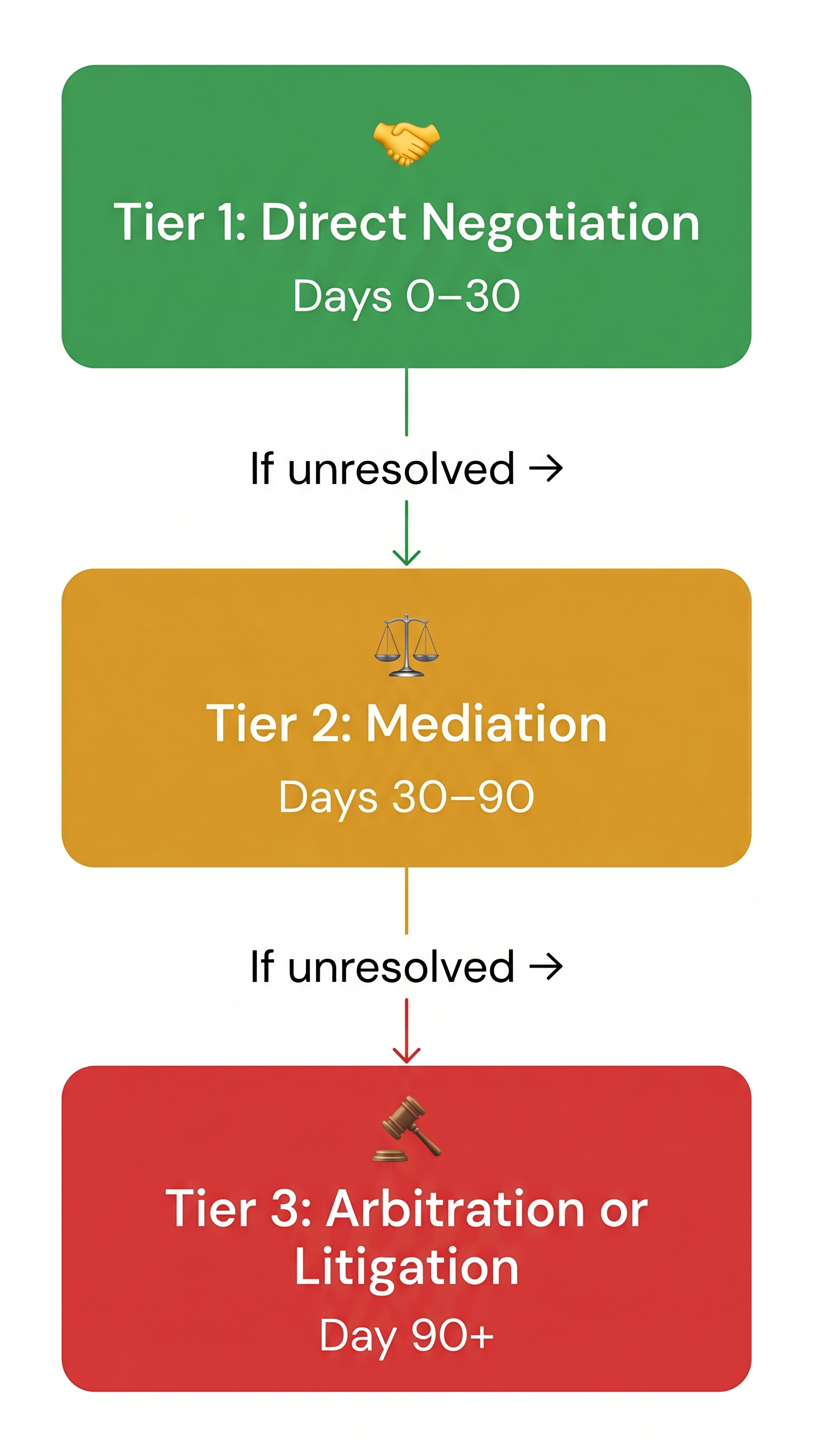
The strongest dispute resolution structure uses three tiers. Each tier filters out disputes before escalating to the next, saving both parties time and money.
Tier 1: Negotiation (0–30 days). Before any formal process, the contract requires both parties to attempt direct resolution. The clause should specify a named contact on each side, a response deadline (usually 10 business days), and a defined escalation trigger.
Tier 2: Mediation (30–90 days). If negotiation fails, the contract mandates mediation through a named provider (AAA or JAMS). Cost is typically split equally. The clause should specify: maximum number of sessions (usually 2–3), mediator selection process, and a deadline for completing mediation.
Tier 3: Binding arbitration or litigation (90+ days). Only if mediation fails within the defined timeframe does either party gain the right to initiate arbitration or file suit. The clause should specify which one. Do not leave it ambiguous.
Sample tiered clause language:
"Any dispute arising under this Agreement shall be resolved as follows: (1) The parties shall first attempt resolution through direct negotiation between designated representatives within 30 days of written notice. (2) If unresolved, the parties shall submit the dispute to mediation administered by [AAA/JAMS] in [location], with costs shared equally, to be completed within 60 days. (3) If mediation fails to produce agreement, either party may initiate [binding arbitration under AAA Commercial Rules / litigation in [court and jurisdiction]]."
This structure is recommended by the American Bar Association's Dispute Resolution Section and used as the default in most MSA (Master Service Agreement) templates. If you're using an MSA-SOW structure for client work, the dispute resolution clause belongs in the MSA, not individual SOWs. One negotiation covers every future project.
Five Dispute Resolution Clause Red Flags
Before signing any contract, check the dispute resolution section for these five patterns that shift risk onto you:
1. Mandatory arbitration with no mediation step. The drafter wants to skip the cheapest resolution method and go straight to the one they can afford and you probably can't. Push for a mediation-first requirement.
2. Out-of-state venue with no remote option. If you'd have to fly across the country to pursue a $10,000 claim, the clause effectively eliminates your ability to dispute. Negotiate for mutual venue or remote proceedings.
3. One-sided fee allocation. "The losing party shall pay all arbitration costs and attorney's fees" sounds fair until you realize it deters the smaller party from filing at all. Look for "each party bears its own costs" or "costs allocated by the arbitrator based on the merits."
4. Waiver of class action or joinder. Post-Concepcion, these waivers are enforceable in most U.S. jurisdictions. If you're signing a consumer or employment contract, this means you can only challenge the company individually, even if thousands of others have the same complaint.
5. Arbitrator selection by one party. Certain clauses let the drafter choose the arbitrating body or even name a specific arbitrator. The arbitrator should be selected through the provider's standard process (usually a strike list where both parties eliminate candidates) or by mutual agreement.
What to Do Before You Sign a Dispute Resolution Clause
Step 1: Read the clause in full. Dispute resolution provisions are typically buried in the last third of a contract, after indemnification and limitation of liability sections. They may span multiple paragraphs with cross-references to other sections.
Step 2: Identify the dispute method, venue, and fee allocation. Mark whether the clause mandates arbitration, mediation, litigation, or a tiered approach. Note the venue city and state. Note who pays filing fees and arbitrator costs.
Step 3: Calculate your worst-case cost. If a $30,000 dispute arose tomorrow, how much would it cost to pursue under this clause? Add filing fees (AAA: $1,925+), arbitrator fees ($1,000–$2,500/day for 2–5 days), travel costs, and attorney fees. If the total exceeds the claim, the clause is effectively unenforceable in your favor.
Step 4: Propose specific changes. Don't ask "can we change the dispute resolution clause?" Instead, propose: "I'd like to add mediation as a mandatory first step before arbitration, change the venue to the respondent's state of residence, and include a provision for remote hearings on claims under $25,000." Specific redline requests get accepted far more frequently than vague objections.
Step 5: Use an AI review tool for pattern detection. AI contract review tools like Pact (iOS) can flag out-of-state venue clauses, missing mediation steps, one-sided fee allocations, and class action waivers automatically, catching issues that are easy to miss in a 20-page contract. For disputes involving force majeure or severability issues, the interaction between those clauses and the dispute resolution method matters.
Frequently Asked Questions

About Vlad Kuzin
Founder & CEO, Shepherdstack LLC
Vlad Kuzin is the founder of Shepherdstack LLC and creator of Pact, an AI-powered contract review tool. He builds software that helps individuals and small businesses understand the documents they sign.
Disclosure: Founder of Shepherdstack LLC, the company behind Pact. All comparison articles use a standardized evaluation methodology applied equally to all tools, including Pact.