
Severability Clauses: Why One Bad Provision Shouldn't Void Your Entire Contract
A severability clause keeps your contract enforceable even if a court strikes down one of its provisions. Without this clause, a single void or unenforceable term (an illegal non-compete, an excessive late fee, a usurious interest rate) can give a court grounds to throw out the entire agreement. The severability clause instructs the court to remove the defective provision and preserve everything else.
This matters more than most contract signers realize. Courts regularly invalidate individual contract provisions: non-compete clauses that are too broad, penalty clauses that exceed statutory limits, arbitration terms that are unconscionable. A severability clause ensures that when one provision fails, the rest of your contract (the payment terms, the scope of work, the intellectual property assignment) survives intact.
What a Severability Clause Does (and What It Doesn't)
A severability clause operates as a savings mechanism. It tells the court three things:
1. Intent to preserve. The parties intended the agreement to survive even if individual provisions are found void, illegal, or unenforceable. Without this stated intent, certain courts apply a presumption that the parties would not have entered the agreement without the invalidated term.
2. Scope of removal. The unenforceable provision should be severed (removed or modified) rather than destroying the entire contract. The clause may specify whether the court should strike the provision entirely ("strike-and-sever") or reform it to the minimum enforceable version ("blue-pencil" or "reformation").
3. Independence of remaining terms. Each remaining provision is independent and enforceable on its own. This prevents a domino effect where voiding one clause is used to argue that related clauses should also fall.
What severability doesn't do: It cannot save a contract whose core purpose is illegal. If the entire agreement exists to facilitate something unlawful, a severability clause will not preserve it; courts will not enforce the remaining provisions of an agreement whose central object is void. The Supreme Court addressed this boundary in Buckeye Check Cashing v. Cardegna (2006), distinguishing between challenges to a specific provision versus challenges to the contract's existence.
Severability Clause Strength Grading Rubric
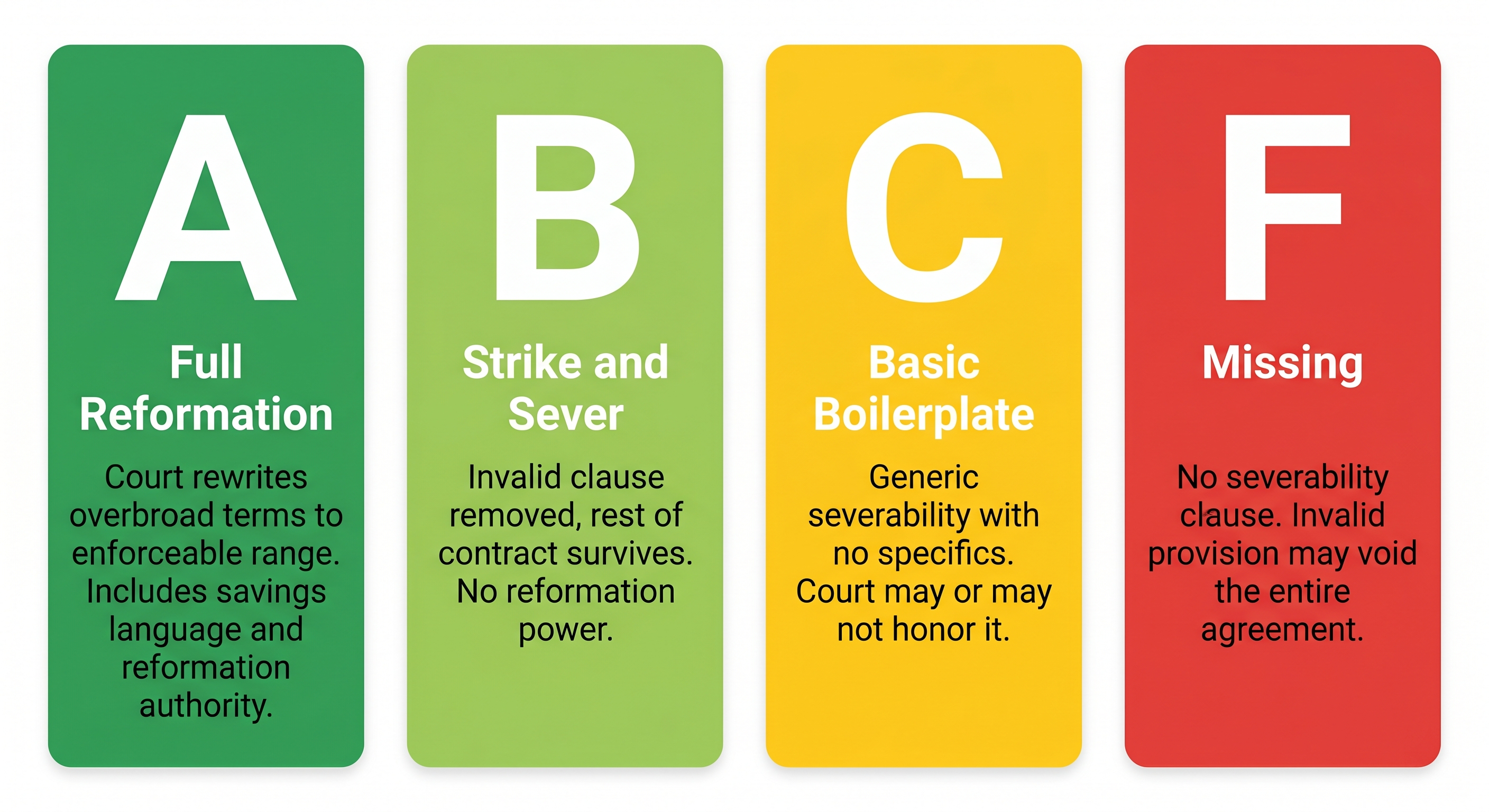
Not all severability clauses provide equal protection. We grade four real-world clause patterns from A (strongest) to F (weakest) based on five criteria: scope of coverage, reformation mechanism, savings language, blue-pencil compatibility, and gap-filling provision.
Grade A: Full Reformation with Savings Language
"If any provision of this Agreement is held by a court of competent jurisdiction to be invalid, void, or unenforceable, the remaining provisions shall continue in full force and effect. The invalid provision shall be reformed to the minimum extent necessary to make it valid and enforceable while preserving the parties' original intent."
Why it's strong: This clause does three things right. It preserves the remaining contract, it instructs the court to reform (not just strike) the bad provision, and it gives the court a standard for reformation: "minimum extent necessary" tied to "original intent." Courts in reformation-friendly states (California, New York, Texas) can narrow an overbroad non-compete to a reasonable scope rather than voiding it entirely.
Grade B: Strike-and-Sever with Explicit Independence
"If any provision of this Agreement is determined to be unenforceable or invalid under any applicable law, such provision shall be severed from this Agreement. All other provisions shall remain in full force and effect, and the invalidity of a severed provision shall not affect the validity of the remaining provisions."
Why it's good but not great: It clearly severs the bad provision and states the remaining provisions are independent. But it does not include a reformation mechanism: the court can only strike, not reform. In a non-compete dispute, this means the entire restrictive covenant falls instead of being narrowed to an enforceable scope.
Grade C: Basic Boilerplate
"If any provision herein is found to be invalid, the remaining provisions shall remain in effect."
Why it's weak: One sentence, no reformation mechanism, no explicit independence of remaining provisions, no standard for how courts should handle the gap left by the removed provision. Courts will still apply it, but they have no guidance on how to handle edge cases, such as whether to reform a partially invalid provision or strike it entirely.
Grade F: Missing Entirely
No severability clause at all. Without it, the court applies default rules for the governing jurisdiction. In certain states, courts will sever unenforceable provisions by default if the contract appears severable in nature. In others, particularly where the void provision is central to the agreement, the court may void the entire contract. You're gambling on the judge's discretion and the jurisdiction's default rule.
Grading Summary Table
| Criterion | Grade A | Grade B | Grade C | Grade F |
|---|---|---|---|---|
| Preserves remaining provisions | Yes — explicit | Yes — explicit | Yes — minimal | No clause |
| Reformation mechanism | Yes — reform to minimum enforceable | No — strike only | No | N/A |
| Blue-pencil compatible | Yes — courts can modify | No — must void | No | N/A |
| Gap-filling standard | "Original intent" | None — gap left open | None | N/A |
| Independence of provisions stated | Implicit in reformation | Yes — explicit | No | N/A |
When Severability Clauses Matter Most: Five Real-World Scenarios
1. Non-Compete and Non-Solicitation Agreements
Non-competes are the most frequently litigated contract provision in employment and freelancer contracts. Courts regularly strike down non-competes that are too broad in scope, geography, or duration. As of 2024, 47 states allow non-competes under varying conditions, but the enforceability thresholds differ dramatically: California bans them almost entirely, while Florida enforces them readily.
A Grade A severability clause with reformation language lets the court narrow an overbroad non-compete (e.g., reducing "worldwide" to "within 50 miles" or "5 years" to "1 year") rather than voiding it. Without severability, the entire restrictive covenant, including reasonable non-solicitation provisions, may fall.
2. Excessive Late Fees and Penalty Clauses
Late fee provisions frequently cross the line between enforceable liquidated damages and unenforceable penalties. A Kansas Supreme Court case in 2025 upheld a $21,000 late fee against a tenant. In states that cap late fees at 5 to 10% of rent or require a relationship to actual damages, fees that exceed these thresholds are void as penalties.
With a severability clause, the court strikes the illegal late fee but preserves the rest of the lease: rent obligations, maintenance terms, security deposit rules. Without it, a tenant could argue the entire lease is void because it contains an illegal penalty provision.
3. Usurious Interest Rates
Lending agreements that charge interest rates above state usury caps are void in the offending provision. Certain lenders include a "usury savings clause": a specialized severability provision that automatically reduces the interest rate to the maximum legal amount if the stated rate exceeds the statutory limit. The American Bankruptcy Institute notes that courts generally enforce these savings clauses, though certain jurisdictions treat intentional usury differently from accidental overcharges.
4. Warranty Disclaimers and Limitation of Liability
Limitation of liability clauses are sometimes voided as unconscionable, particularly when the cap is extremely low relative to the contract value, or when the clause attempts to disclaim liability for gross negligence. A warranty disclaimer that violates consumer protection law (e.g., disclaiming implied warranties in a state that prohibits such disclaimers) would also be struck. Severability ensures the core commercial terms survive.
5. Arbitration Clauses
When courts find an arbitration clause unconscionable, such as requiring a $14,500 filing fee for a worker earning $20,800 (as in Uber v. Heller), severability determines whether the parties fall back to litigation under the remaining contract terms, or whether the entire agreement is void. Most well-drafted agreements treat the dispute resolution clause as severable.
How to Draft a Strong Severability Clause
Step 1: Include reformation language. Don't settle for simple strike-and-sever. Add: "The invalid provision shall be reformed to the minimum extent necessary to make it valid and enforceable." This gives courts the power to fix provisions rather than destroy them.
Step 2: State the independence of provisions. Add: "Each provision of this Agreement is independent. The invalidity of any provision shall not affect the validity or enforceability of any other provision." This prevents domino arguments.
Step 3: Specify the governing standard. Add: "Reformation shall preserve the original intent of the parties as closely as possible." This gives courts a clear standard instead of leaving them to guess.
Step 4: Consider jurisdiction-specific language. If you operate in a blue-pencil state (most common-law jurisdictions), the reformation language in Step 1 aligns with the court's existing power. If you operate in a strict-severability state, courts may only have the power to strike, not reform, so your clause should explicitly grant reformation authority "to the fullest extent permitted by applicable law."
Step 5: Place the clause correctly. Severability belongs in the "General Provisions" or "Miscellaneous" section alongside governing law, force majeure, and dispute resolution. It should appear in every contract you sign, regardless of type: from NDAs to commercial leases to software licenses.
Frequently Asked Questions

About Vlad Kuzin
Founder & CEO, Shepherdstack LLC
Vlad Kuzin is the founder of Shepherdstack LLC and creator of Pact, an AI-powered contract review tool. He builds software that helps individuals and small businesses understand the documents they sign.
Disclosure: Founder of Shepherdstack LLC, the company behind Pact. All comparison articles use a standardized evaluation methodology applied equally to all tools, including Pact.