
Lease Agreement Review Checklist: How to Spot Hidden Gotchas Before Signing
Ninety-seven percent of residential leases contain at least one clause that tenants don't fully understand before signing, and roughly 30% include provisions that may be unenforceable in the tenant's state. A lease is a binding contract. Once signed, you are locked into every term for the full lease period, including the ones buried on page 8 that you did not read carefully. This checklist breaks your lease review into 10 scored risk dimensions so you know exactly what to negotiate before you sign.
The Lease Red Flag Scoring System
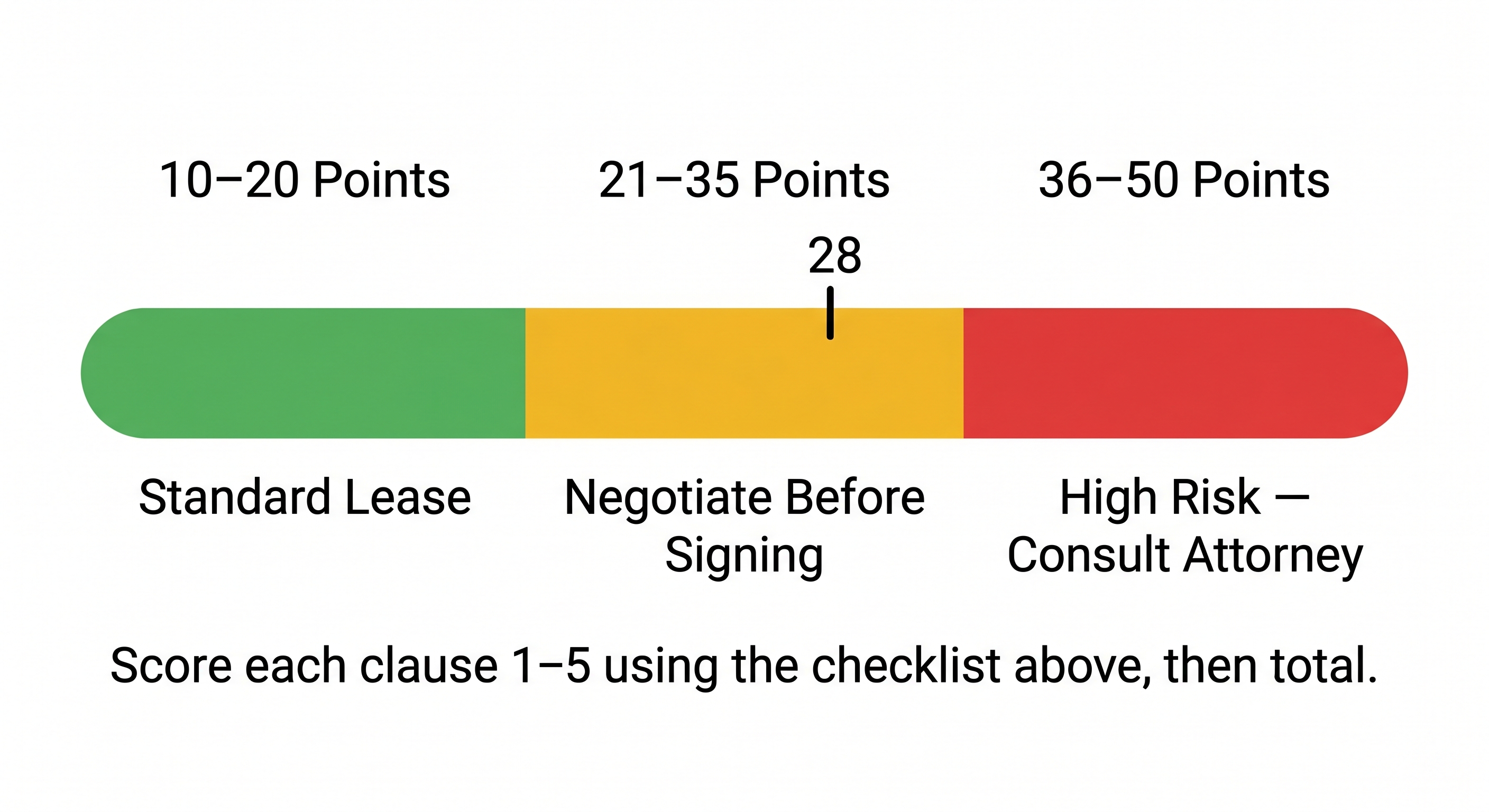
Score each clause category 1–5 points based on risk level. Total your score to determine your overall lease risk profile.
| Risk Category | 1 Point (Standard) | 3 Points (Negotiate) | 5 Points (Walk Away) |
|---|---|---|---|
| Rent escalation | Fixed rent for full term | Annual increase tied to CPI (2–4%) | Landlord discretion ("may adjust rent at any time") |
| Security deposit | 1 month, clear return conditions, 30-day return timeline | 1–2 months, vague deduction criteria | 2+ months, no itemized deduction requirement, landlord retains for "damages" |
| Auto-renewal | No auto-renewal; converts to month-to-month | Auto-renews unless 60+ day written notice | Auto-renews for full term unless 90+ day notice (easy to miss) |
| Entry/access rights | 24–48 hour written notice except emergencies | "Reasonable notice" (undefined) | Unlimited landlord access for "inspections" |
| Maintenance obligations | Landlord covers structural, plumbing, HVAC, appliances | Tenant covers minor repairs under $100 | Tenant responsible for "all repairs and maintenance" |
| Subletting | Allowed with landlord approval (not unreasonably withheld) | Prohibited but lease can be assigned with approval | Absolutely prohibited, no assignment option |
| Early termination | 60-day notice + 1 month penalty | 2-month penalty + forfeiture of security deposit | No early termination permitted; liable for full remaining rent |
| Noise/use restrictions | Standard quiet hours (10pm–8am) | Broad restrictions on "nuisance" (subjective) | Lease prohibits working from home, guests staying 3+ nights, or having pets |
| Utilities | All utilities separately metered, tenant pays own | Some utilities included, unclear allocation | Landlord controls heating/cooling, no metering transparency |
| Late fees | $25–$50 flat fee after 5-day grace period | 5% of monthly rent, no grace period | Percentage-based penalty + daily accumulation + no cap |
Score interpretation:
- 10–20 points: Standard lease. Normal risk level. Sign with confidence after verifying the specific terms.
- 21–35 points: Negotiate before signing. The lease contains provisions that shift disproportionate risk to you. Identify the 3-point and 5-point items and propose specific changes.
- 36–50 points: High risk. Multiple red flags suggest the lease is drafted to maximize landlord advantage. Either negotiate aggressively or find a different property.
Rent and Payment Terms: What to Check First
Base Rent and Escalation
Your lease should state the exact monthly rent, the due date, accepted payment methods, and any scheduled increases. The safest structure: fixed rent for the full term, or annual increases tied to a published index (Consumer Price Index) with a stated cap (typically 3–5%).
Red flag: "Landlord may adjust rent upon 30 days' notice" or "rent shall increase at landlord's discretion." These clauses give the landlord unlimited ability to raise rent during your lease term, effectively making your "12-month lease" a rolling month-to-month at whatever price the landlord chooses.
State law check: Rent control cities (New York, San Francisco, Los Angeles, and over 180 municipalities nationwide) cap annual increases regardless of what the lease says. If your property is in a rent-controlled jurisdiction, a clause allowing discretionary increases may be unenforceable, but you still need to know it is there.
Late Fees
Late fee enforceability varies by state. California caps residential late fees at 6% of rent. New York courts generally require late fees to be "reasonable" (typically $25–$50 or 5% of rent, whichever is less). A lease charging 10% of rent per day as a late fee is almost certainly unenforceable, but challenging it requires legal action.
Best practice: Verify your state's late fee rules before signing. If the lease's late fee exceeds state guidelines, ask the landlord to adjust it. If they refuse, the severability clause in the lease (if one exists) means the illegal late fee gets struck but the rest of the lease survives.
Security Deposit
Every state regulates security deposits. Key questions:
- Maximum amount: Most states cap deposits at 1–2 months' rent. Charging more may be illegal.
- Holding requirements: Most states require deposits held in separate interest-bearing accounts with the bank name disclosed to the tenant.
- Return timeline: Ranges from 14 days (Hawaii) to 60 days (Alabama) after lease termination.
- Itemized deductions: Most states require landlords to provide itemized deduction statements. "General wear and tear" is not a valid deduction in any state.
Maintenance, Repairs, and Habitability
Who Fixes What
The lease should clearly divide maintenance responsibilities. Standard allocation:
Landlord responsible for: Structural integrity (roof, walls, foundation), plumbing systems, electrical systems, HVAC, provided appliances, common areas, and any condition that affects habitability.
Tenant responsible for: Minor upkeep (changing lightbulbs, unclogging drains from personal use, yard care if applicable), damage caused by the tenant or guests, and cosmetic issues caused by tenant use.
Red flag: "Tenant shall be responsible for all repairs and maintenance of the Premises." This shifts the landlord's habitability obligations onto you, which is illegal in most states. Every state has an implied warranty of habitability requiring landlords to maintain livable conditions regardless of what the lease says.
Request and Response Timelines
Your lease should specify how to request maintenance (written form, email, portal) and the landlord's response timeline. A common Reddit complaint: landlords who take weeks to address maintenance requests. Without a stated timeline, you have no benchmark for "unreasonable delay."
Reasonable provision: "Landlord shall respond to maintenance requests within 48 hours and complete non-emergency repairs within 14 business days. Emergency repairs affecting habitability (no heat, no hot water, flooding) shall be addressed within 24 hours." Before move-in, use our inspection checklist to document the property's condition and protect your security deposit.
Entry and Access Rights
Landlord entry rights are one of the most commonly abused lease provisions. Every state except a handful requires landlords to provide advance notice before entering, typically 24–48 hours, and only for specified purposes (repairs, inspections, showings to prospective tenants).
What to check:
- Does the lease specify a notice period? (If not, state law applies, but explicitly stating it prevents disputes.)
- Does the lease define permitted entry purposes? (Repairs, inspections, and emergencies, but not "any time landlord deems necessary.")
- Does the lease restrict entry hours? (Business hours only, or specific time windows.)
Red flag: "Landlord may enter at any time for inspections." This violates tenant privacy protections in most states. Even in lease-friendly jurisdictions, unlimited entry rights are a sign that the landlord does not respect legal boundaries and a preview of the landlord-tenant relationship to come.
Lease Term, Renewal, and Termination
Auto-Renewal Traps
Auto-renewal clauses that require 60–90 days' notice to opt out are the most common "gotcha" in residential leases. Miss the notice window by one day, and you're locked in for another full term.
Safe structure: The lease converts to month-to-month after the initial term, terminable with 30-day notice by either party.
Risky structure: The lease auto-renews for a full additional term (usually 12 months) unless the tenant provides written notice 90 days before expiration. Set a calendar reminder for 100 days before your lease ends.
Early Termination
Most leases include an early termination penalty: typically 1–2 months' rent. A minority also require forfeiture of the security deposit on top of the penalty. The most tenant-unfavorable version: no early termination clause, meaning you are liable for the full remaining rent on the lease.
Negotiation point: If the lease doesn't include an early termination clause, ask for one. "Tenant may terminate this Lease upon 60 days' written notice and payment of [1 month's rent / 2 months' rent] as an early termination fee." This gives you an exit at a known cost.
State law backstop: Most states require landlords to mitigate damages by making reasonable efforts to re-rent the unit. Even without an early termination clause, you may not owe the full remaining rent if the landlord can find a replacement tenant.
Restrictions on Use, Guests, and Pets
Use Restrictions
Certain leases prohibit working from home, operating a business, or having guests stay more than a specified number of consecutive nights (typically 7–14). If you work remotely, verify the lease does not restrict home-based work.
Pet Policies
Pet deposits, monthly pet rent ($25–$75 is typical), breed restrictions, weight limits, and pet liability insurance requirements should all be stated clearly. Verify whether "no pets" means no pets or whether service/emotional support animals are excluded per federal Fair Housing Act requirements (they always are; landlords cannot charge pet fees for service animals).
Modification and Improvement Rights
Can you paint the walls? Install shelving? Mount a TV bracket? The lease should specify what modifications are permitted, whether they require landlord approval, and whether you must restore the unit to original condition at move-out.
Lease Agreement Review with AI Tools
AI contract review tools scan lease agreements for common loopholes and unfavorable clauses automatically. For tenants reviewing a lease before signing, AI tools flag:
- Late fees that exceed state guidelines
- Missing return timelines for security deposits
- Maintenance clauses that shift landlord obligations to tenants
- Auto-renewal terms with long notice requirements
- Illegal clauses that are unenforceable but still intimidating
For a technical look at how these tools work under the hood, see our explainer on AI-powered review. Pact (iOS) provides clause-level risk analysis on lease agreements in under 5 minutes, identifying which provisions are standard, which are negotiable, and which may be unenforceable in your jurisdiction. For tenants without legal expertise, AI review functions as a first-pass screening that tells you whether the lease needs a lawyer's attention or is safe to sign.
Frequently Asked Questions

About Vlad Kuzin
Founder & CEO, Shepherdstack LLC
Vlad Kuzin is the founder of Shepherdstack LLC and creator of Pact, an AI-powered contract review tool. He builds software that helps individuals and small businesses understand the documents they sign.
Disclosure: Founder of Shepherdstack LLC, the company behind Pact. All comparison articles use a standardized evaluation methodology applied equally to all tools, including Pact.